Alexandre Piatti
Contact details and information
Contact
11 Rue de Beaune, 75007 Paris, France
Hours
Open from Monday to Saturday, 10:00 a.m. to 1:00 p.m. and 2:00 p.m. to 7:00 p.m.

About
Alexandre Piatti opened his gallery in 2010 in the "Carré Rive Gauche" district of Paris and is committed to promoting Haute Époque art.
The son of an antique dealer, he grew up in the art world from an early age, working with objects that are deeply familiar to him.
The Haute Époque is a broad period encompassing works of rare and distinctive eclecticism. However, Alexandre Piatti has consistently succeeded in presenting carefully selected pieces in a way that creates harmony and a strong curatorial identity.
The gallery’s ambition is to reinterpret and bring a renewed sense of modernity to works that have marked the art of the Middle Ages and the Renaissance.
The Haute Époque is a broad historical period encompassing objects of rare and distinctive eclecticism.
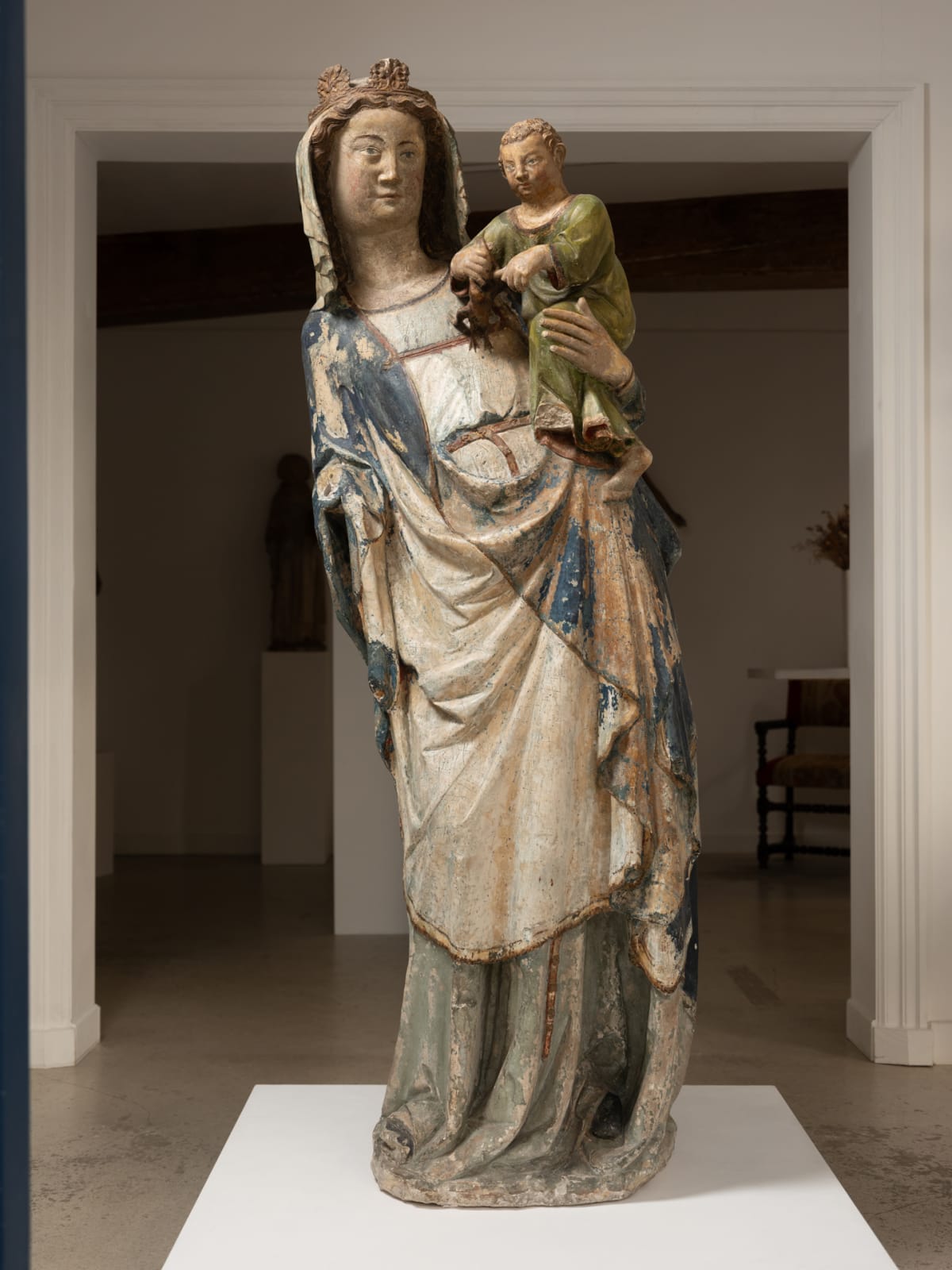
VIRGIN AND CHILD Lorraine, c. 1330–1340
This monumental Virgin and Child, carved from polychromed limestone, comes from the former Cistercian Abbey of Haute-Seille in Lorraine. Standing 171 cm (67⅜ in.) high, it ranks among the most important surviving Gothic sculptures from the region and exemplifies the refinement of the Lorraine workshops during the first third of the fourteenth century.
Influenced by Parisian sculpture of the late thirteenth century, the work is distinguished by its elegant contrapposto stance, the fluidity of its drapery, and the gentle interaction between the Virgin and the Christ Child. The Child holds a small bird, a characteristic motif in medieval iconography symbolizing both His innocence and the foreshadowing of the Passion.
Preserved for centuries in the abbey church of Haute-Seille, the sculpture reflects the central role of Marian devotion within the Cistercian Order. Despite the successive destructions suffered by the abbey throughout its history, the work has survived in an exceptional state of preservation, retaining several campaigns of original polychromy.
Listed as a French Monument historique (object designation) since 1964, this Virgin and Child is a major example of Gothic sculpture in Lorraine. Through its monumental scale, the high quality of its execution, and its distinguished provenance, it stands as one of the finest surviving works of this important medieval artistic tradition.
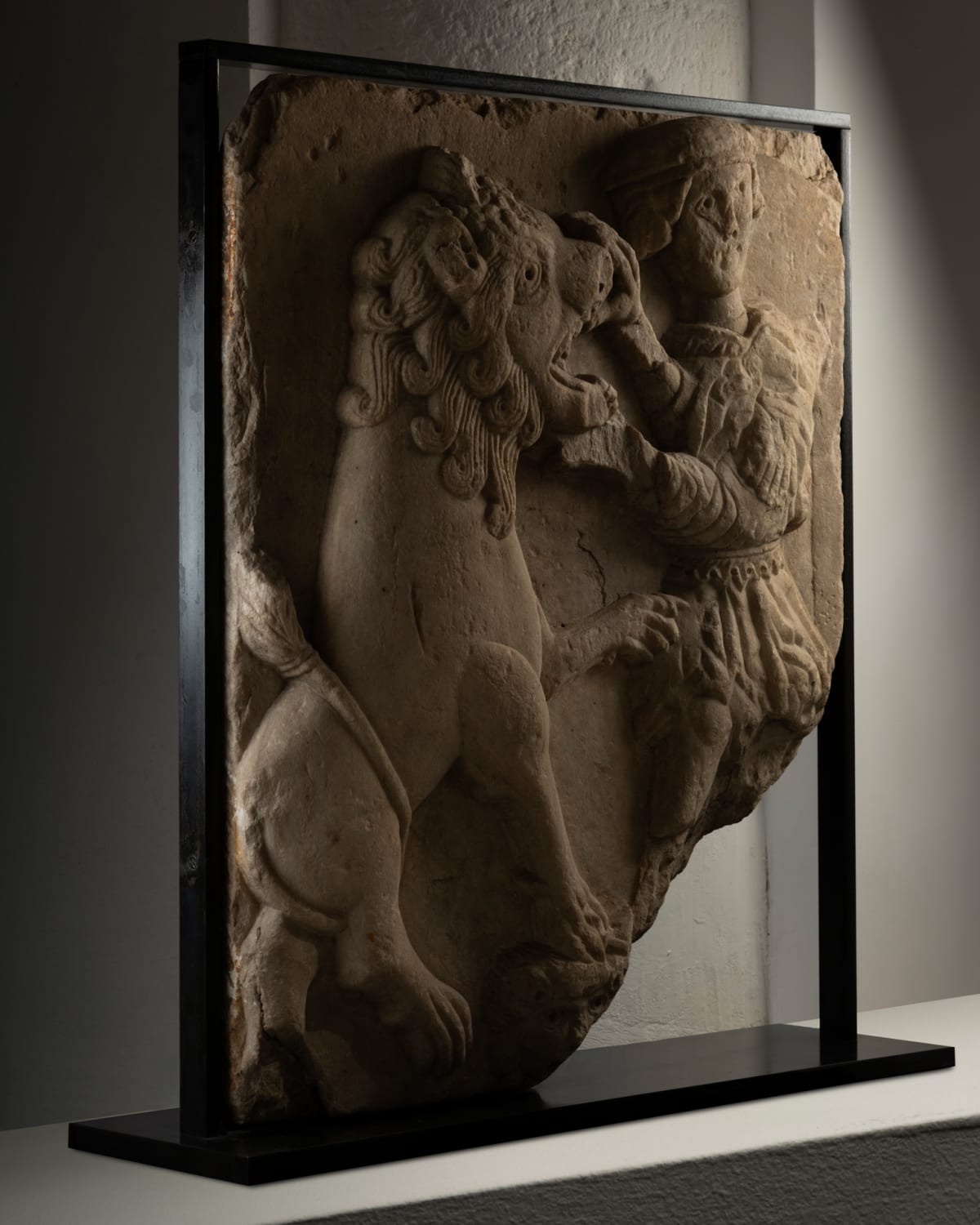
DOUBLE-SIDED PLUTEUS Northern Italy, 12th century
This remarkable Romanesque marble pluteus, carved on both sides, most likely originates from Northern Italy, one of the principal centres of monumental sculpture during the twelfth century. Intended to form part of the liturgical screen separating the choir from the nave, it was far more than a simple architectural element: it served as a powerful didactic image, inviting the faithful to contemplate the central themes of the Christian faith.
The first face depicts the youthful David confronting the lion and the bear, an episode from the First Book of Samuel. In medieval exegesis, this struggle transcends the biblical narrative to become an allegory of faith's triumph over the forces of evil. As both the ideal king and a prefiguration of Christ, David embodies the righteous ruler and the victorious Christian, whose trust in God overcomes violence and disorder.
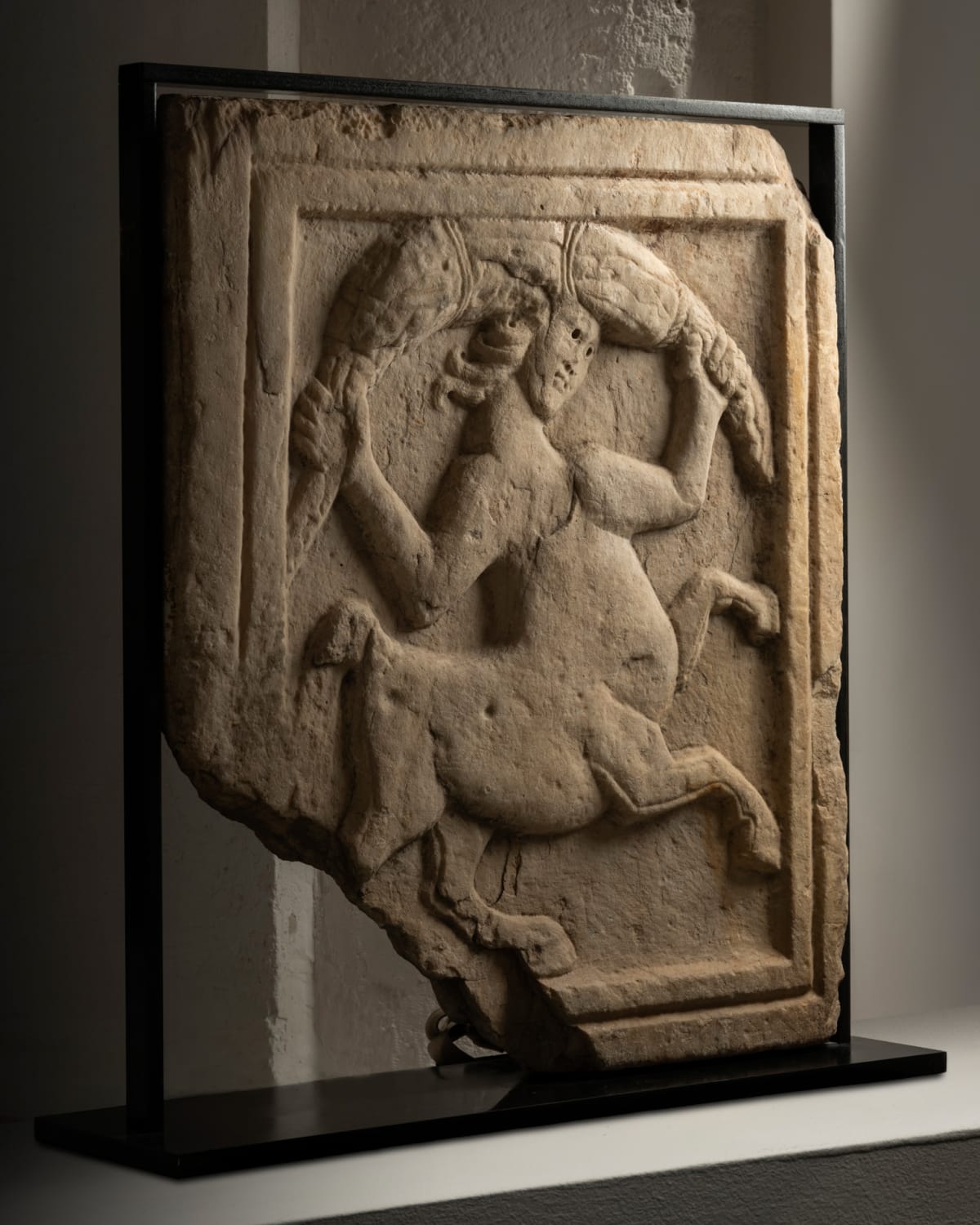
DOUBLE-SIDED ROMANESQUE PLUTEUS Northern Italy, 12th century
The reverse depicts a female centaur carrying a heavy burden. Inherited from Classical antiquity but profoundly reinterpreted in Romanesque art, this hybrid creature symbolizes the dual nature of humanity, torn between reason and instinct. The weight she bears becomes a metaphor for sin—by its nature invisible, yet made tangible through sculpture—reminding the faithful of the spiritual consequences of surrendering to earthly passions.
Through its exceptional double-sided iconography, this pluteus presents a compelling visual meditation on the opposition between virtue and vice, salvation and damnation. Its style, closely related to the workshops of Emilia-Romagna, heirs to Wiligelmo and Niccolò, reflects the richness of Italian Romanesque sculpture, in which the expressive power of form is harnessed to convey a theological message of remarkable depth.
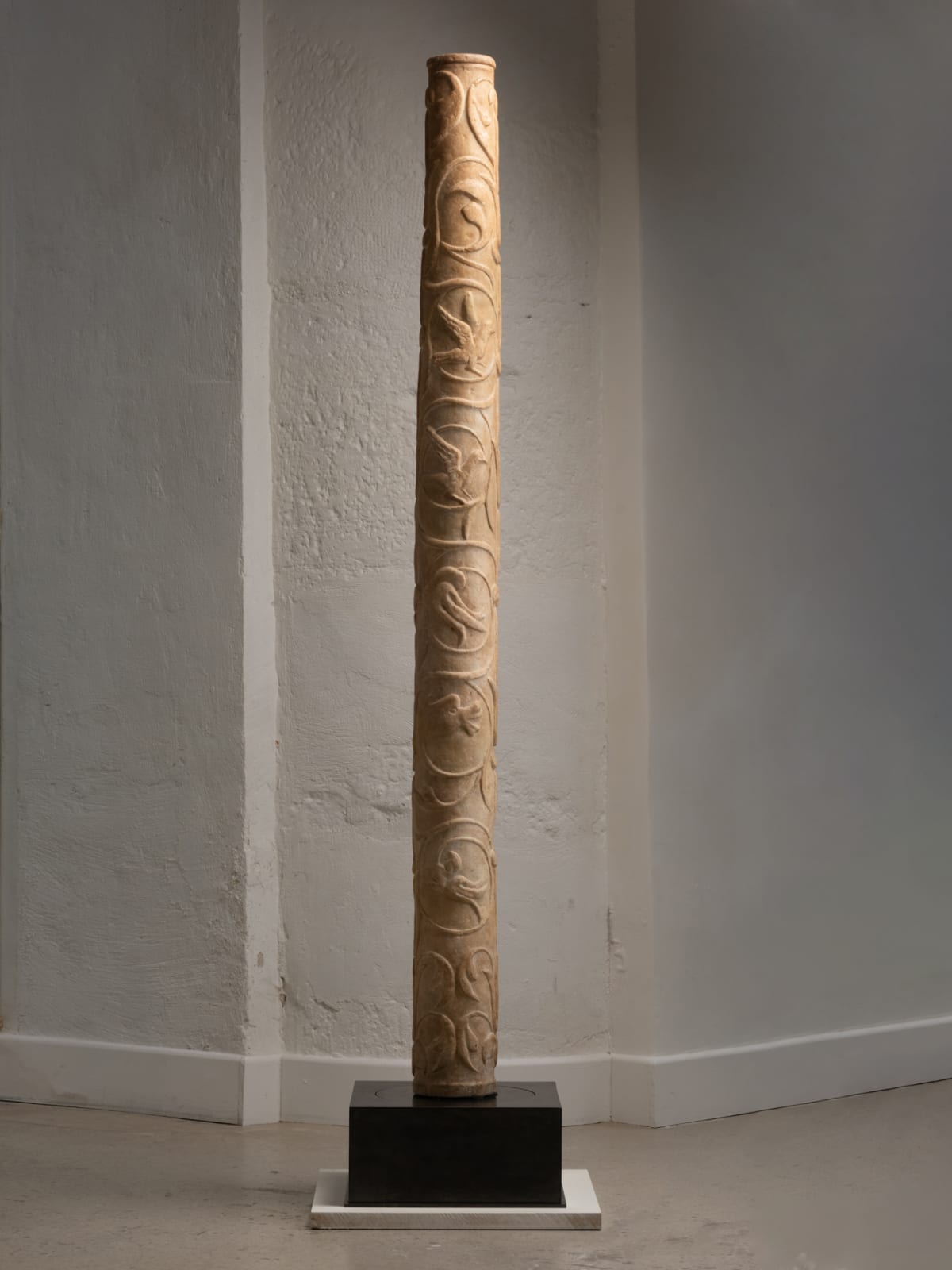
ROMANESQUE COLUMN OF BYZANTINE INSPIRATION Tuscany, Lucca region, 12th century
This elegant marble column, carved in Tuscany during the twelfth century, exemplifies the refinement of the Romanesque workshops of the Lucca region, then one of Italy's foremost artistic centres. Entirely decorated in relief, it is enveloped by an intricate network of scrolling foliage that rises along its full height, naturally emphasizing the column's verticality and drawing the eye upward.
Amid this luxuriant vegetation appear birds and griffin heads, seamlessly intertwined with the scrolling vines. Far from being merely ornamental, these creatures belong to the symbolic vocabulary of Romanesque art. The birds evoke the ascent of the soul, while the griffin—combining the eagle and the lion—symbolizes the union of the earthly and the heavenly realms, as well as vigilant protection.
This decoration belongs to the tradition of the tralcio abitato, or "inhabited vine scroll," inherited from Classical antiquity and profoundly renewed through Early Christian and Byzantine art. Here, the vegetal forms, inspired by the classical acanthus, are infused with new vitality as plants, animals, and fantastic creatures merge into a continuous composition of remarkable elegance.
Through its ornamental vocabulary and rich symbolic content, this column perfectly illustrates the artistic dialogue between Byzantine and Romanesque traditions in twelfth-century Italy. Comparable to the celebrated columns on the façade of the Church of San Martino in Lucca, it constitutes a rare and significant example of medieval architectural sculpture, in which ornament plays a central role in expressing the soul's spiritual ascent toward the divine.