Wanecq
Contact details and information
Contact
12 rue des Saints-Pères
Hours
Open from Tuesday to Saturday, 10:00 a.m. to 1:00 p.m. and 2:00 p.m. to 6:30 p.m.
About
Founded in 1950 by Jean Wanecq, the gallery specializes in 18th-century furniture and art objects.
Built on expertise passed down with passion, the gallery is now directed by his wife, Gertraud Wanecq, alongside Armelle Deschamps. Together, they uphold the standards of authenticity, quality, and elegance that have made the gallery renowned.
At the heart of the gallery, the excellence and refinement of 18th-century French decorative arts is celebrated, a period marked by a rare balance between craftsmanship virtuosity and aesthetic innovation. Each piece presented embodies the spirit of a century in which furniture and art objects went beyond mere function to become true works of expression.
The selection brings together furniture and objects chosen with the highest standards, bearing witness to the exceptional craftsmanship of the master cabinetmakers, joiners, and artisans of the period. From the rigor and strength of the Louis XIV and Regency periods to the elegance of Louis XV, and the neoclassical refinement of Louis XVI, each creation illustrates an evolution in taste and techniques.
The gallery place particular importance on the authenticity, provenance, and condition of each work. The pieces are selected not only for their historical value, but also for their ability to engage in dialogue with contemporary interiors, bringing character, warmth, and uniqueness.
The gallery serves both seasoned collectors and discerning enthusiasts, interior architects, and lovers of art history. It supports each of our clients with a personalized approach based on listening, guidance, and the sharing of our passion.
More than an exhibition space, the gallery is a place of encounter between past and present, where the elegance of the 18th century continues to inspire and enrich today’s perspectives.
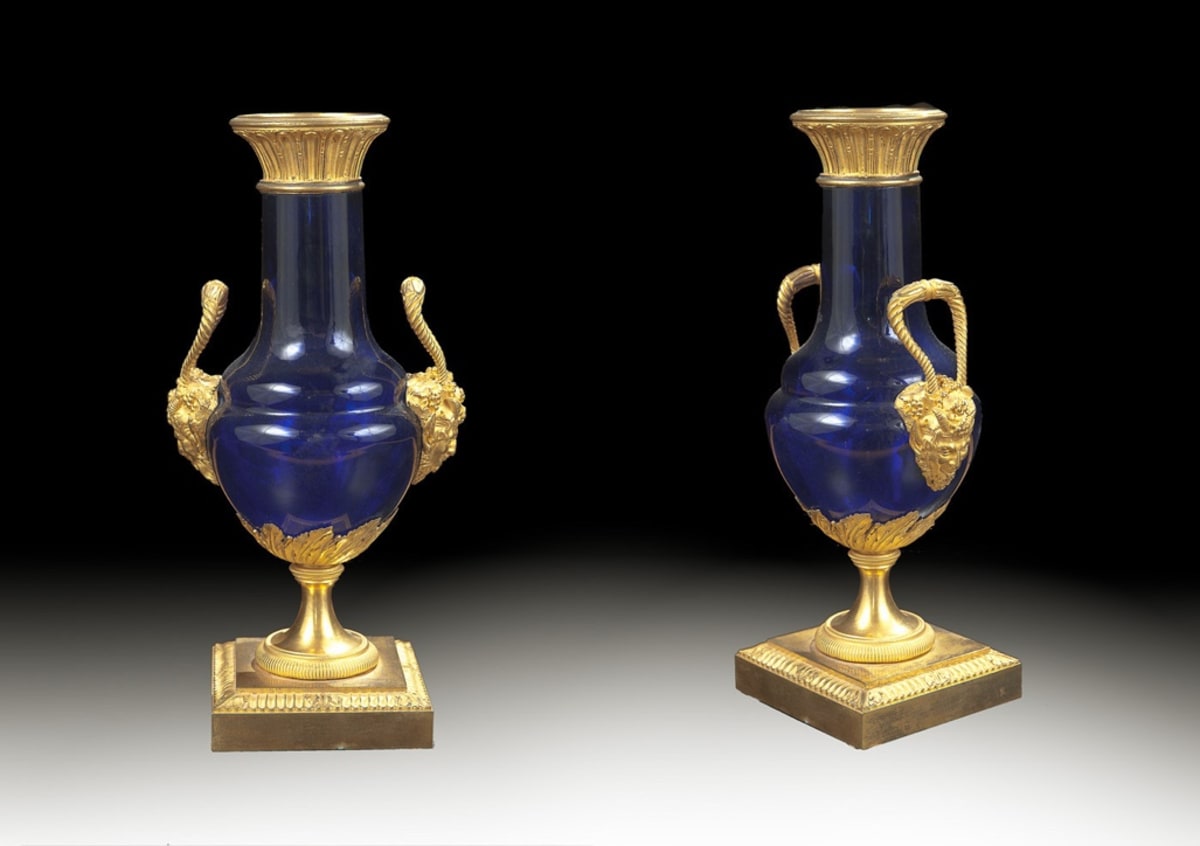
PAIR OF BLUE CRYSTAL VASES FROM LE CREUSOT
LOUIS XVI PERIOD
H. 28 cm. (11 in.), W. 10 cm. (4 in.), D. 10 cm. (4 in.)
Amphora-shaped vases in blue Le Creusot crystal, adorned with a beautiful chiseled and gilded bronze mount featuring a pedestal, handles with faun heads, and a neck decorated with palmette motifs.
Provenance: Galerie Georges Petit, Auction of March 30 and 31, 1925, collection of Mr. R. Boulland
The Creusot glassworks succeeded the Saint-Cloud glassworks in the art of glassmaking. In 1787, it moved from Paris to Mont-Cénis (near Le Creusot in Saône-et-Loire) and was jointly acquired by the Baccarat and Saint-Louis glassworks.
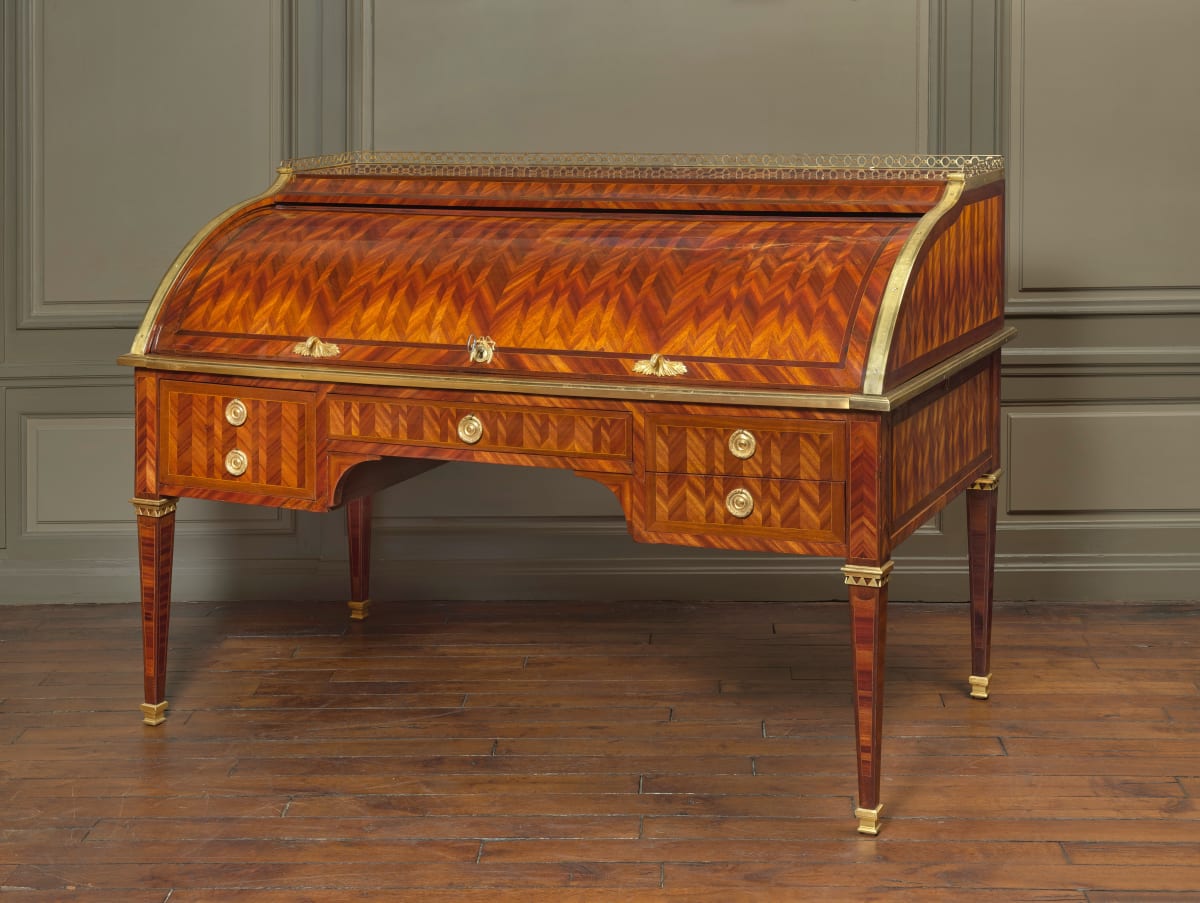
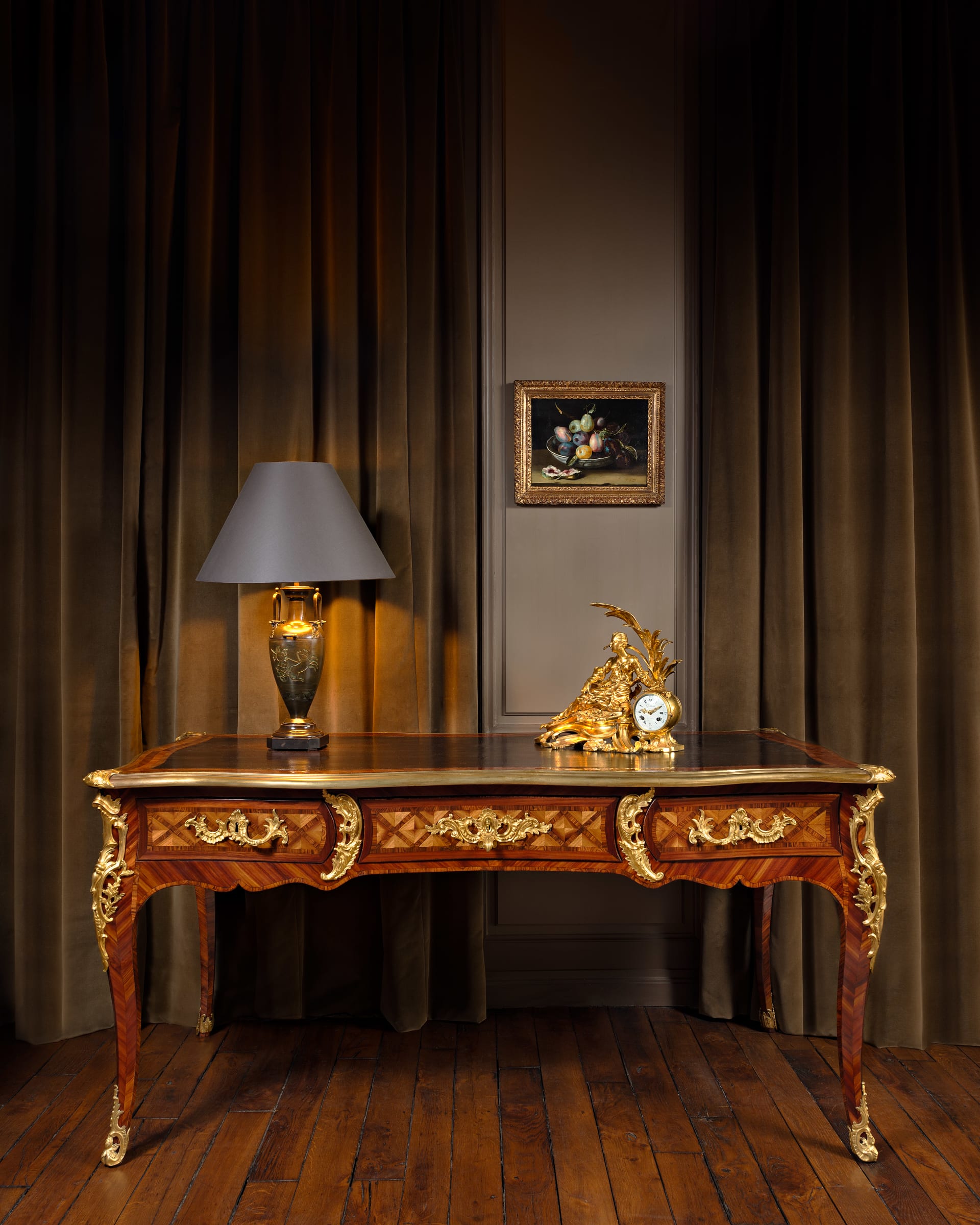
IMPORTANT CYLINDRICAL DESK
STAMPED “LEONARD BOUDIN”
IN COLLABORATION WITH FERDINAND BURY
LOUIS XVI PERIOD
An impressive cylindrical desk adorned with herringbone marquetry of satinwood set within amaranth frames. It features a sliding leather-covered top and three drawers topped by three open compartments. The front opens to reveal four drawers, one of which contains a lockbox. It rests on four sheathed legs.
Beautiful ornamentation of chiseled and gilded bronze, including an openwork gallery with ovate friezes, leaf-motif finger pulls, denticulated rings, and clogs.
Stamped on the right side beneath the desk.
H. 119 cm. (46 ¾ in.), W. 163.5 cm. (64 in.), D. 89 cm. (35 in.)
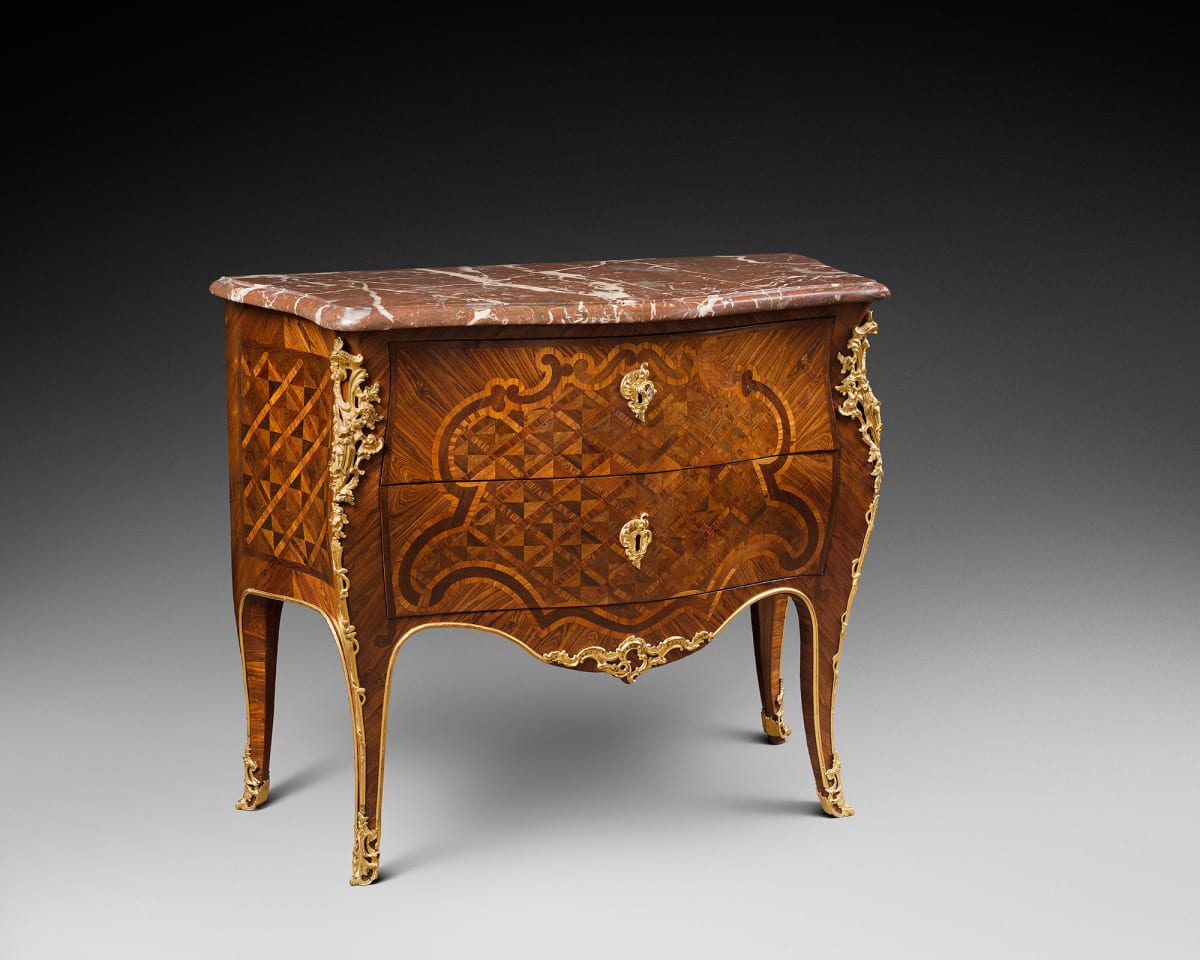
CHEST OF DRAWERS
STAMPED “ALBERT LEVESQUE” — LOUIS XV PERIOD
Curved in shape with two rows of drawers without crossbars, made of rosewood, violetwood, and amaranth veneers. It features a marquetry design of crosshatches and diamond points within dynamic panels composed of amaranth clasp motifs; identical marquetry is found in rectangular frames on the sides. Beautiful chiseled bronze hardware with openwork rocaille, floral, and foliage motifs.
Royal red marble.
H. 80 cm. (31 ½ in.), W. 95.5 cm. (37 ½ in.), D. 50 cm. (19 2/3 in.)
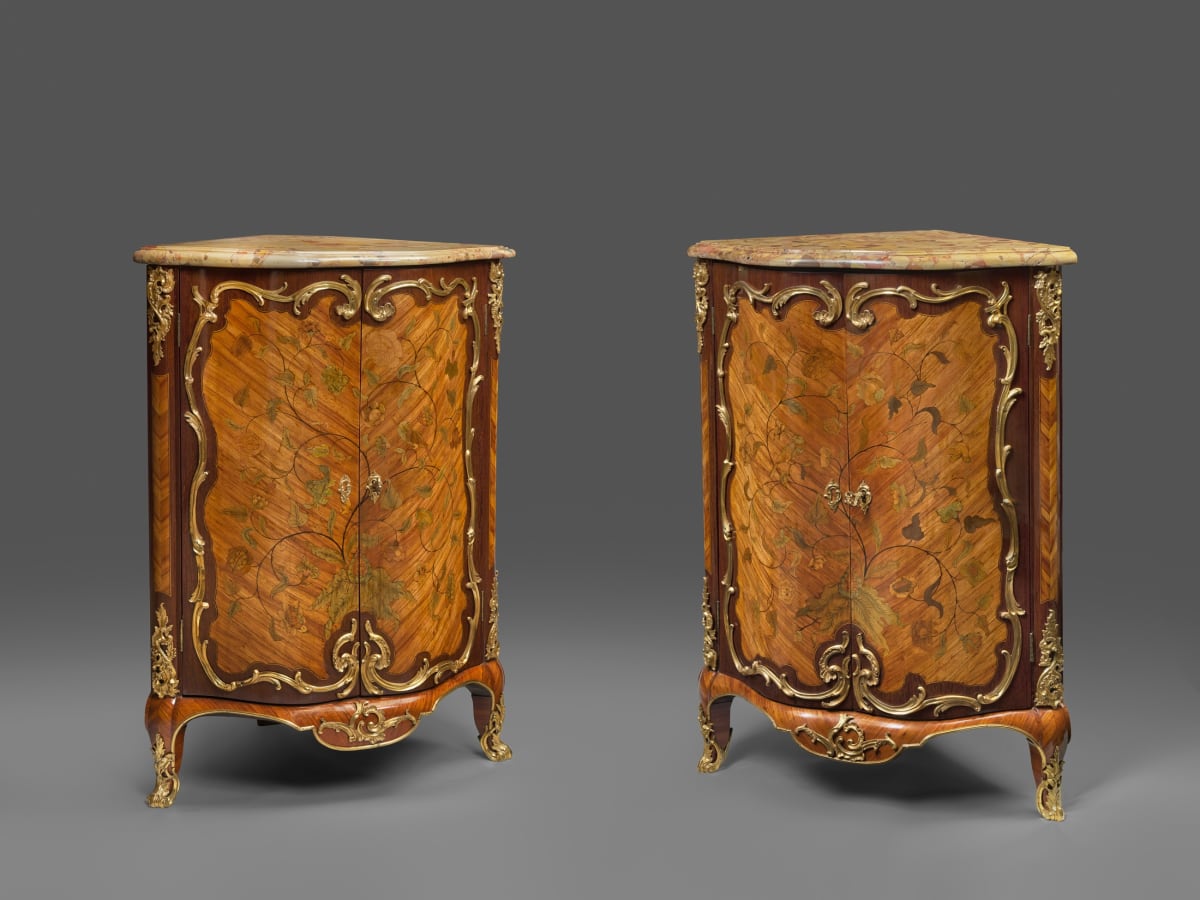
PAIR OF CORNER CABINETS
ATTRIBUTED TO PIERRE IV MIGEON—LOUIS XV PERIOD
CIRCA 1750
H. 97 cm. (38 ¼ in.), W. 68 cm. (26 ¾ in.), D. 50 cm. (19 2/3 in.)
The front features a crossbow-shaped design opening with two panels adorned with leafy and flowering branches animated by birds, executed in end-grain wood marquetry on a rosewood background. The frames are made of amaranth wood and gilded bronze with foliage motifs, retaining their original gilding. The corner pieces, with rounded posts, feature rich ornamentation of rocaille-style gilded bronze elements such as scrolls, clogs, a lock plate, and a lamp base. They rest on short, arched legs.
Top of Aleppo breccia marble.
The design of these corner cabinets—featuring floral and foliage marquetry enlivened by birds, remarkable for its delicacy—is characteristic of Migeon. Also noteworthy is the skillful interplay of the wood grain, with a pattern of grain running with and against the grain, color contrasts, and the use of reserved areas for the bronze mounts, all hallmarks of this cabinetmaker.
Often paired with chests of drawers, these corner cabinets were produced in fairly large numbers by Pierre IV Migeon, although few examples survive today. These one- or two-door corner cabinets, adorned either with a simple geometric veneer or floral marquetry, generally feature a fairly curved silhouette. The front of the piece follows a sinuous line whose curves extend along the sides.
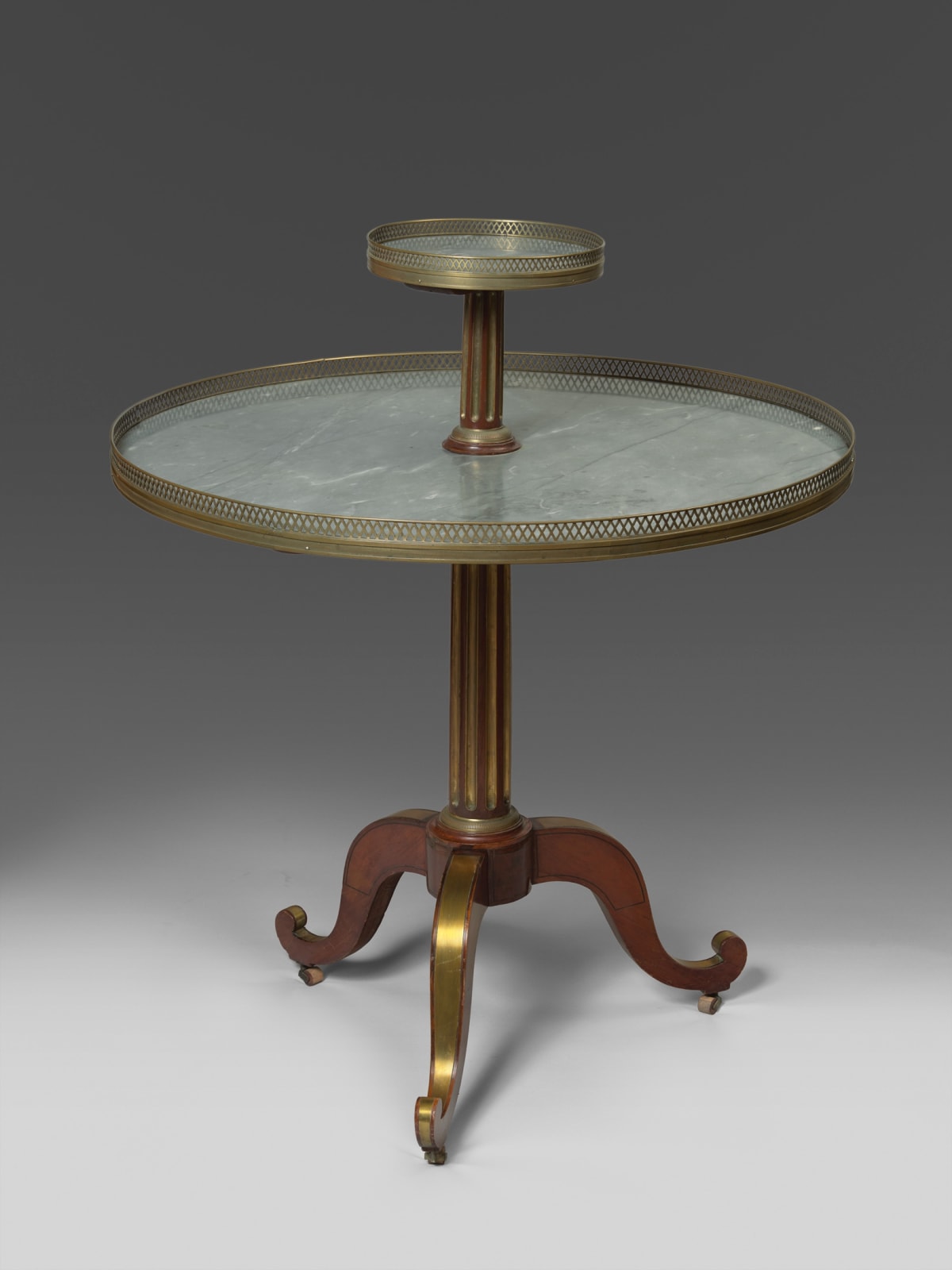
LOUIS XVI-PERIOD SILENT SERVING TABLE
IN THE MANNER OF MOLITOR—LOUIS XVI PERIOD
Made of mahogany, with double turquin blue marble tops encircled by an openwork bronze rail, supported by a shaft with dark brass fluting, it rests on a tripod base finished with casters.
H. 100 cm. (39 1/3 in.), Diam. 81 cm. (31 ¾ in.)
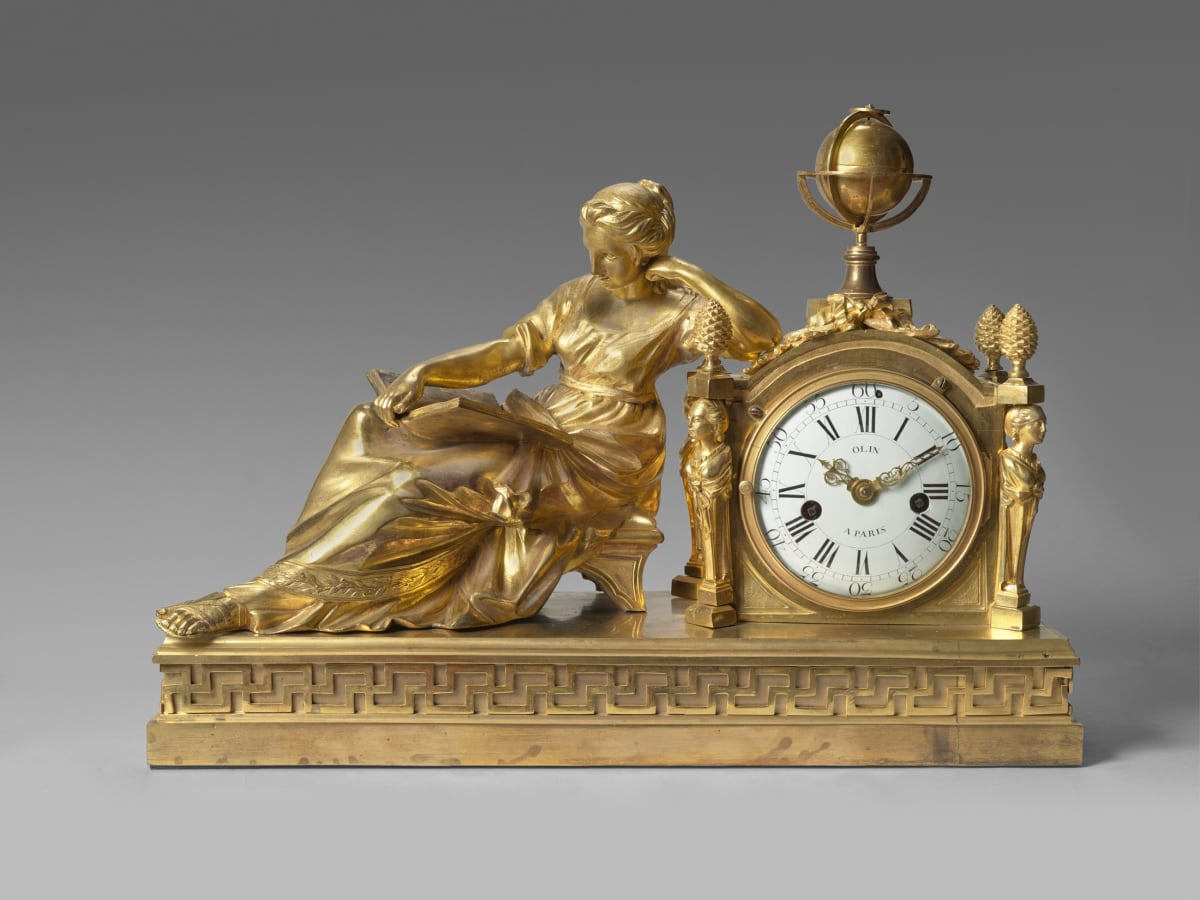
MONUMENTAL “À LA GEOFFRIN” CLOCK
LOUIS XVI PERIOD—CIRCA 1770
H. 45 cm. (17 ¾ in.), W. 64 cm. (25 in.), D. 22 cm. (8 ½ in.)
A significant neoclassical clock known as “à la Geoffrin,” crafted from very finely chased and gilded bronze, adorned with a design of knotted ribbons, pinecones, and female figures in full-length poses. It depicts a woman dressed in ancient style, seated and leaning against a milestone while reading. This allegory of study is also known as “the use of time.” The dial, signed “OLIN A PARIS,” is surmounted by a sphere. The entire piece rests on a base adorned with a frieze of Greek motifs.
This model of clock was collected by notable figures such as Denis Diderot, the Marquis de Marigny, and the Duke of Choiseul. A Geoffrin-style clock also appears on the famous Choiseul snuffbox, recently acquired by the Louvre.
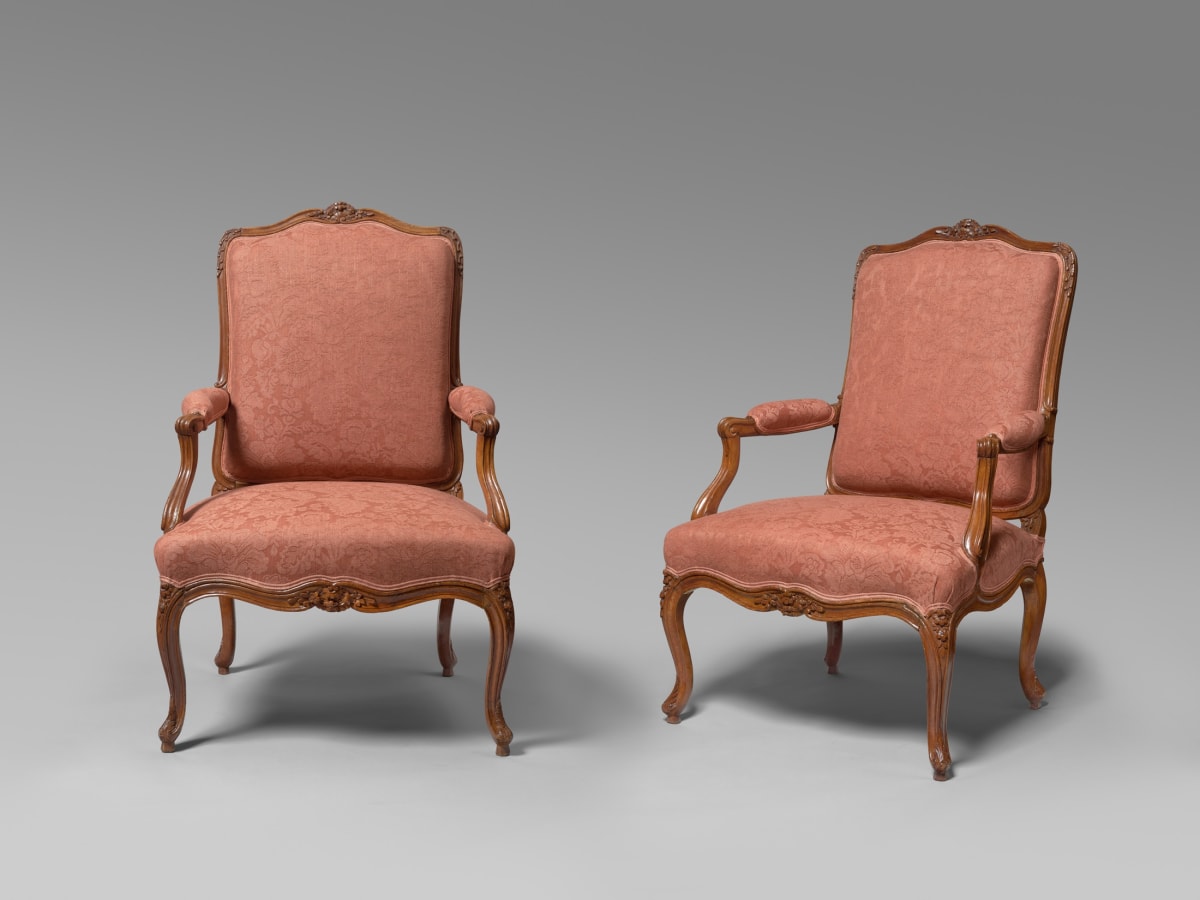
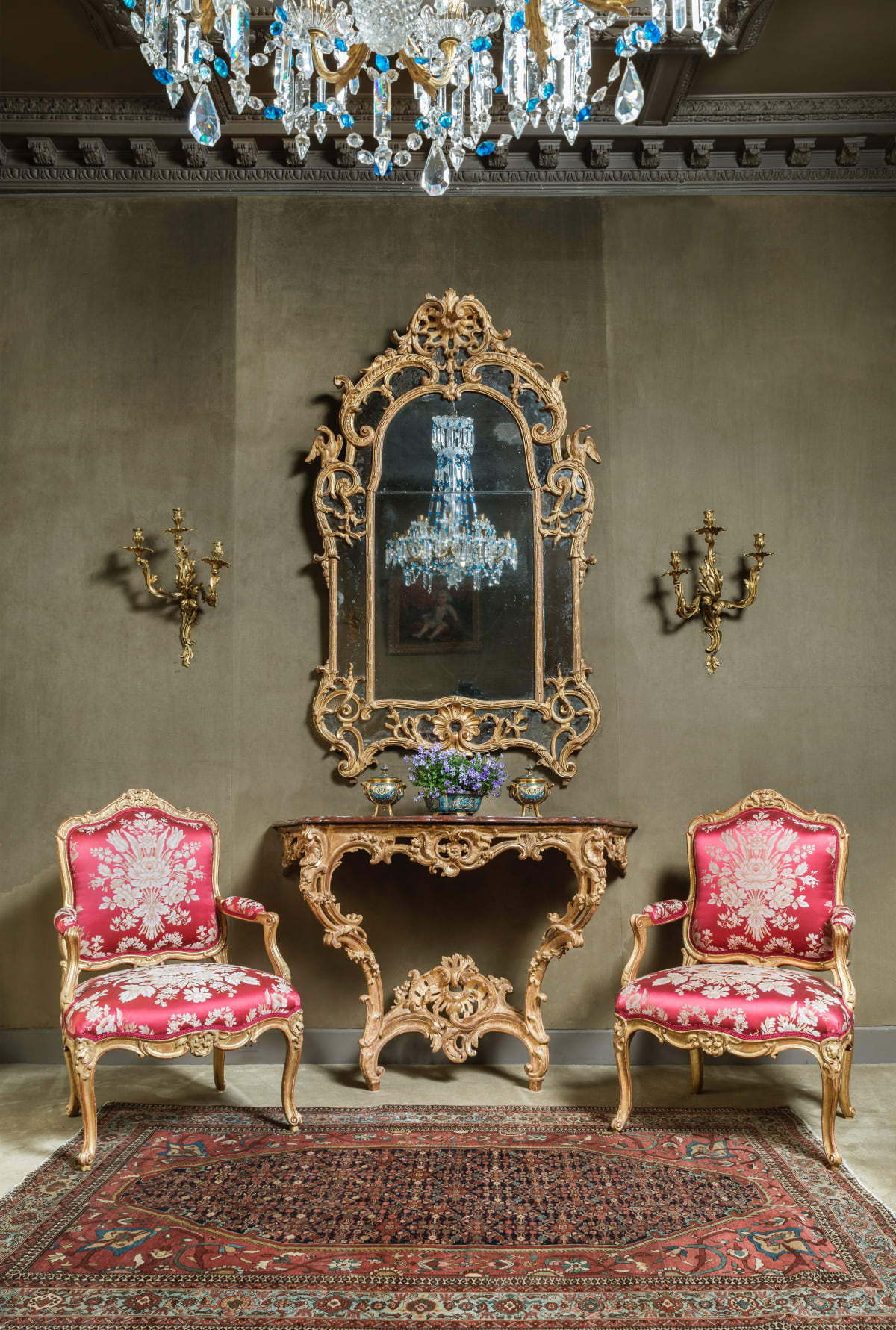
PAIR OF LARGE “A LA REINE” ARMCHAIRS
MARKED “IG” FOR JEAN GOURDIN — LOUIS XV PERIOD
CIRCA 1750–1760
H. 108 cm. (42 ½ in.), W. 72 cm. (28 ¼ in.), D. 65 cm. (25 ½ in.)
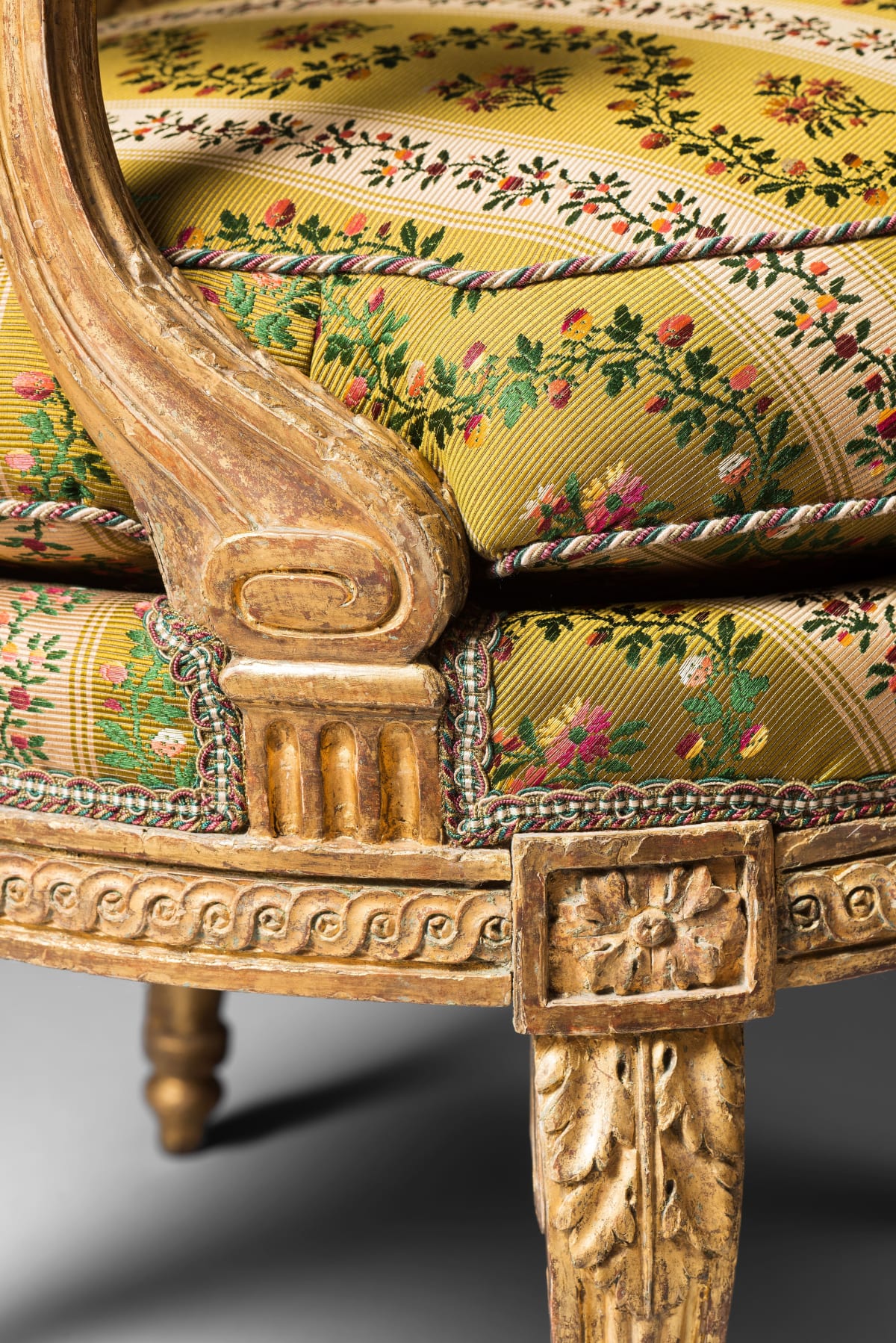
Made of molded and carved beech wood, the backrest is adorned with a garland of mistletoe on the shoulders and carved wild roses in the center. The armrests, featuring cuffs that end in scrolls, rest on whip-shaped consoles.
The center of the apron and the tops of the legs are adorned with the same flowers.
The arched legs are topped with acanthus leaves.
The entire chair is accentuated by moldings.
One of the chairs is stamped “IG” for Jean Gourdin
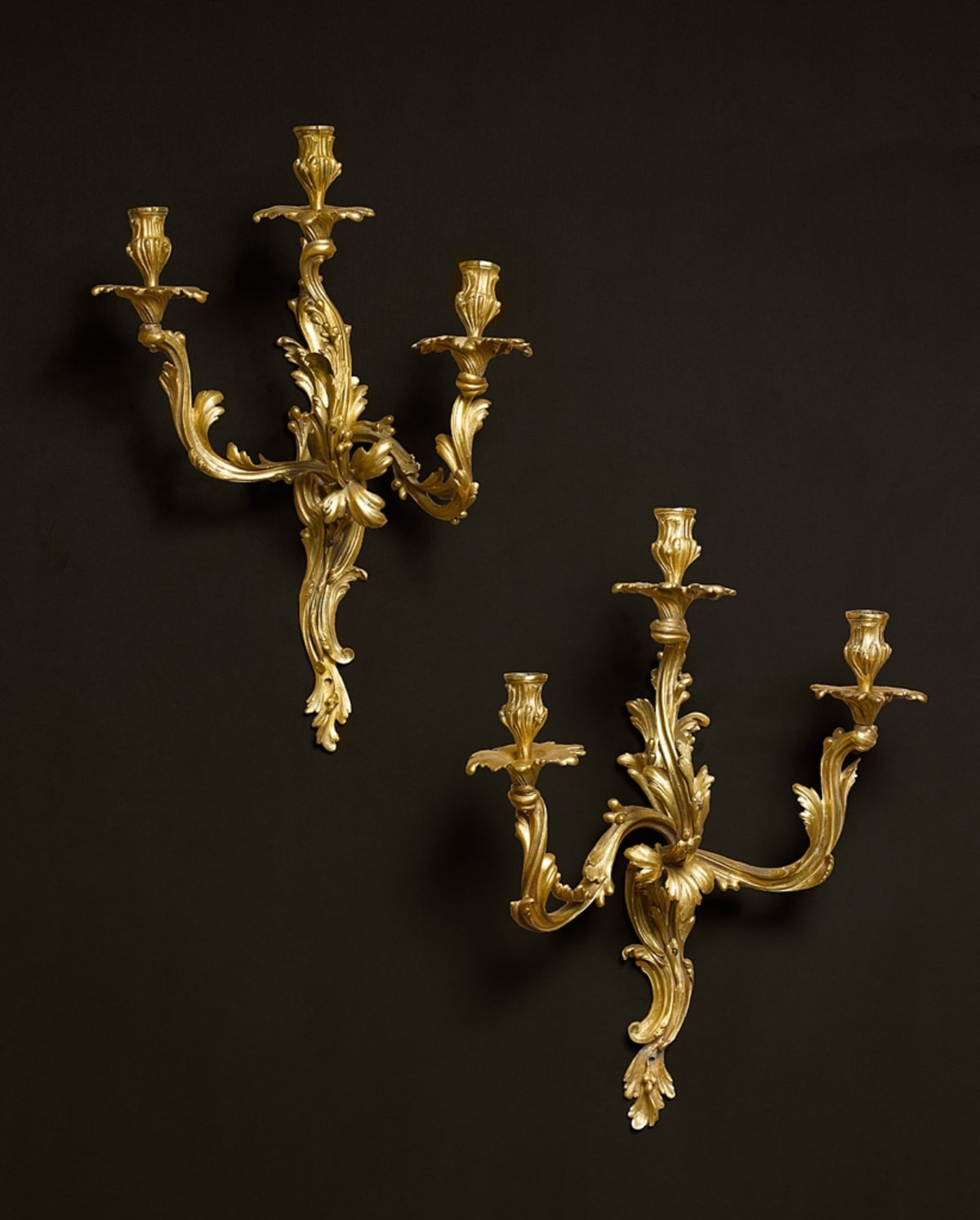
PAIR OF ROCAILLE WALL SCONCES
LOUIS XV PERIOD
H. 59 cm. (23 1/4 in.), W. 41 cm (16 in.)
Made of bronze with three asymmetrical light arms adorned with acanthus foliage and seed motifs; the shaft features high relief decoration, with leaf-decorated finials and sockets. Original gold varnish.
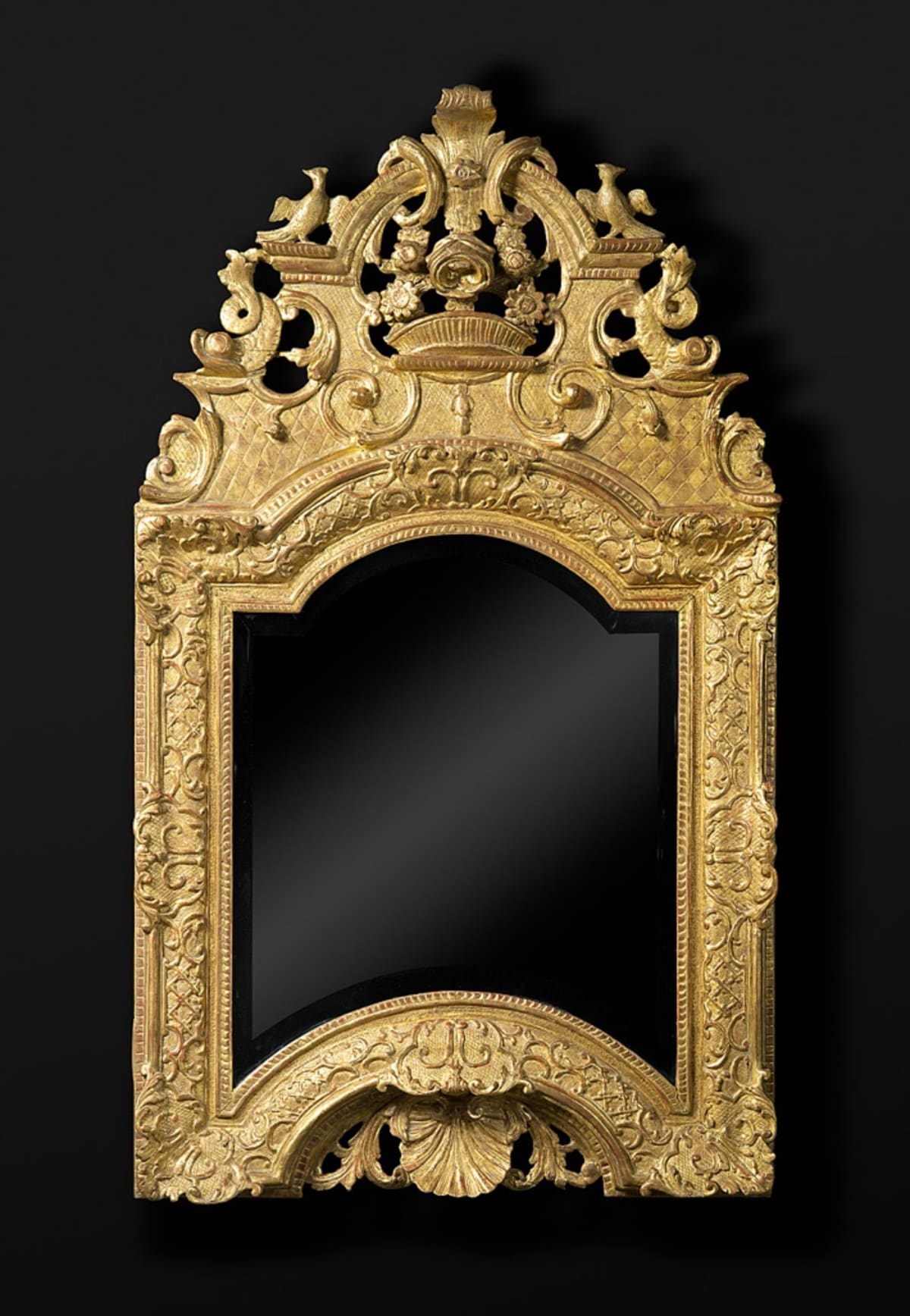
CARVED AND GILDED WOODEN MIRROR
LOUIS XIV PERIOD
H. 118 cm. (46 1/2 in.), W. 68 cm. (26 3/4 in.)
A rare example of a frame with an openwork pediment adorned with a floral basket surrounded by dolphins, birds, and foliage; it surmounts a Bérain-style frame featuring an extremely rare inverted design at its base, decorated with a shell surrounded by acanthus leaves.
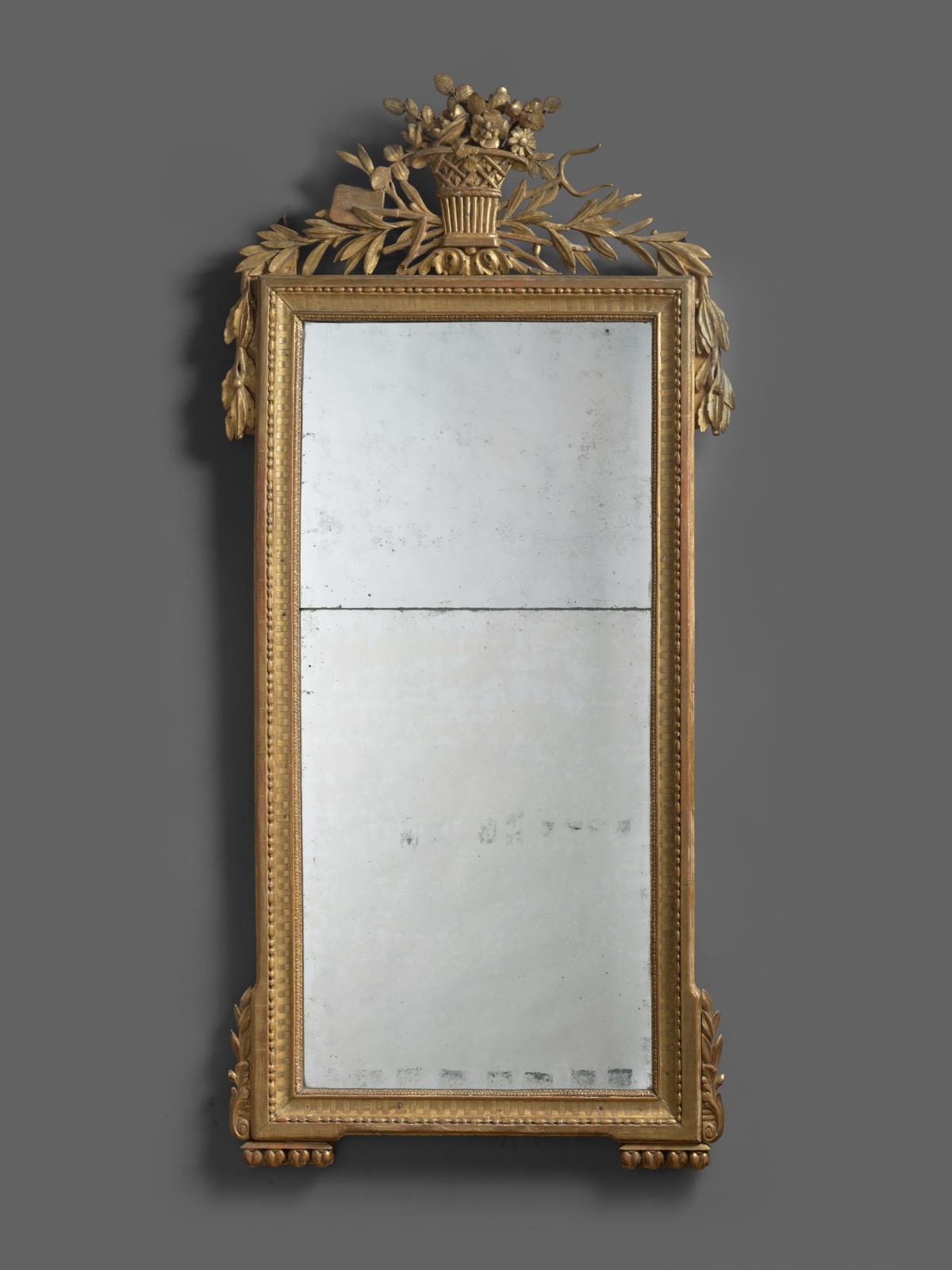
MIRROR
LOUIS XVI PERIOD – circa 1780
H. 195 cm (76 ¾ in.) W. 95 cm (37 1/3 in.)
Gilded, molded wooden mirror. Topped by a flower-filled basket surrounded by a crossed spade and pitchfork, the gardener’s tools. Foliage cascades from the basket in garlands down the upper sides of the mirror.
The lower corners are framed by a shelf resting on leaves, from which a branch of foliage extends.
The interior of the frame is molded with three distinct rows of beads, tongues, and geometric motifs.
The mirror consists of two panels.
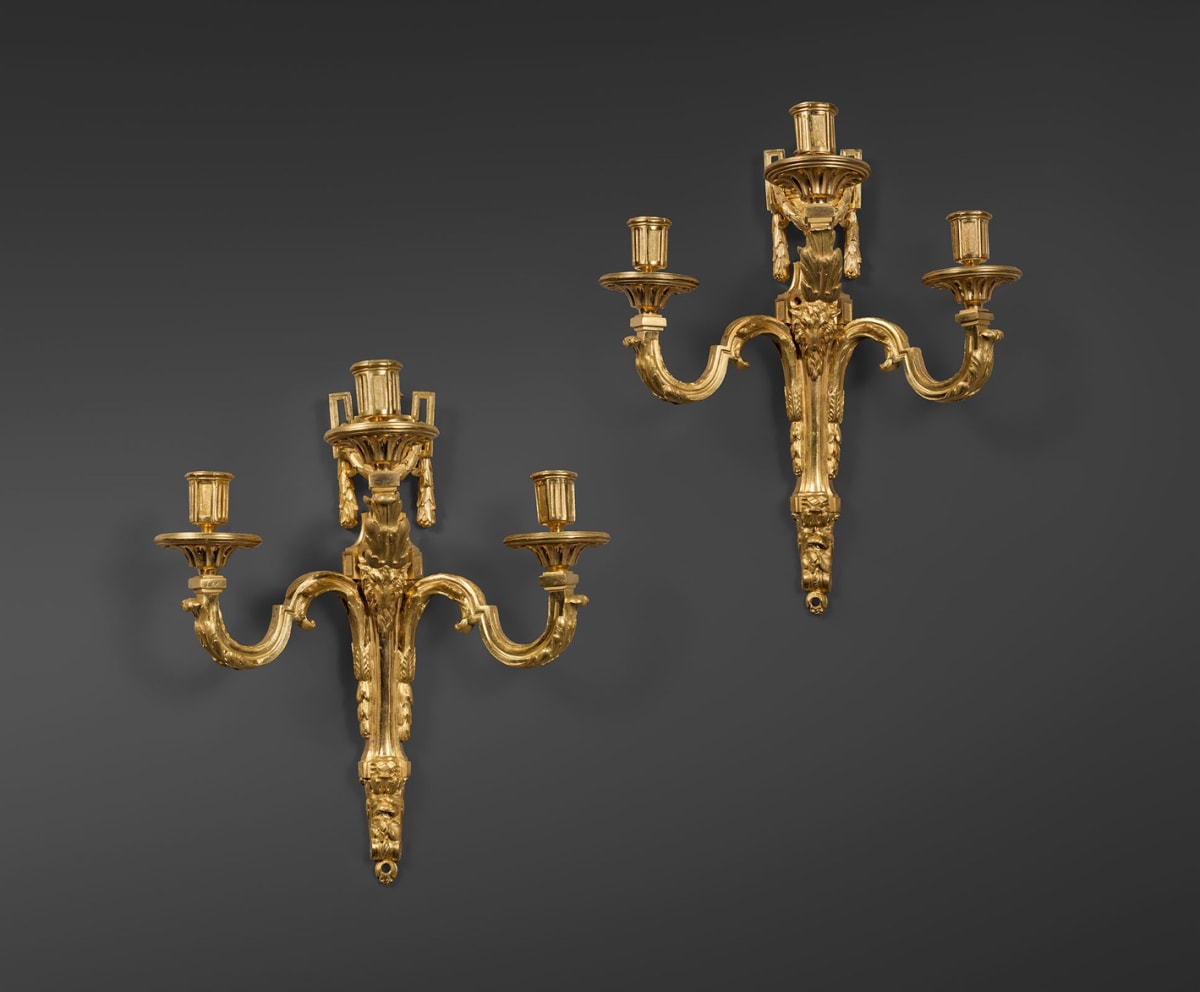
PAIR OF WALL SCONCES IN THE GREEK STYLE
IN THE STYLE OF QUENTIN-CLAUDE PITOIN
LOUIS XVI PERIOD
H. 47 cm. (18 1/2 in.), W. 39 cm. (15 1/3 in.)
Made of finely chiseled bronze, the shaft is adorned with laurel garlands and a ram’s head. The ensemble is topped by a covered vase.
They feature three “S”-shaped light arms decorated with acanthus leaves.
Quentin-Claude Pitoin (c. 1725–1777), who was admitted as a Master Sculptor to the Académie de Saint-Luc on June 14, 1752, was the first in his family to abandon woodworking in favor of the bronze trade, taking over from his father-in-law in 1763 as a supplier to the Garde-meuble de la Couronne. He notably employed the prestigious technique of matte gilding.
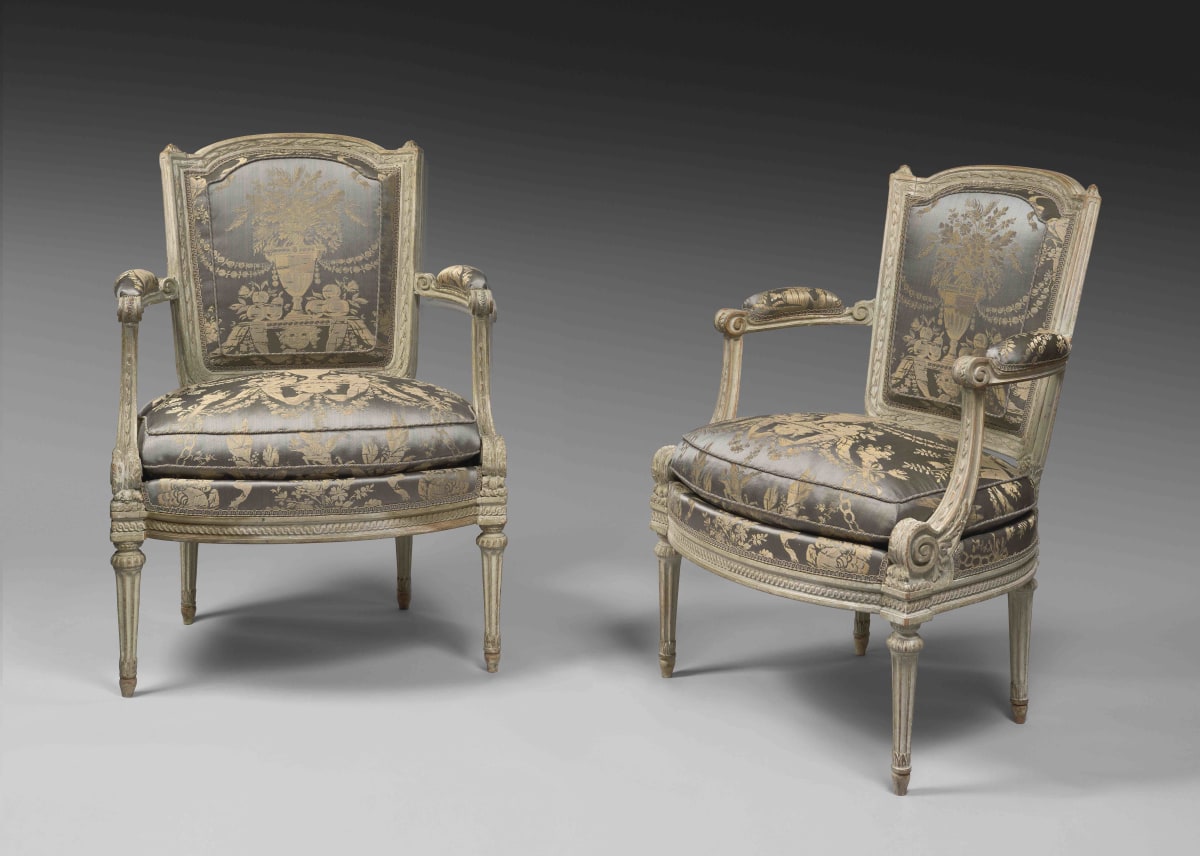
RARE PAIR OF LACQUERED ARMCHAIRS
MARKED J-B BOULARD—LOUIS XVI PERIOD
Made of molded and carved beech wood, lacquered gray, and richly carved with laurel garlands on the basket-handle-shaped backs. The armrests and their consoles are finished and accented with scrollwork highlighted by cascading medallions, laurel leaves, and acanthus leaves. The band around the wide seats is carved with an interlaced frieze. Tapered, fluted legs topped with acanthus leaves.
H. 89 cm. (35 in.), W. 65 cm. (25 ½ in.), D. 55 cm. (21 2/3 in.)
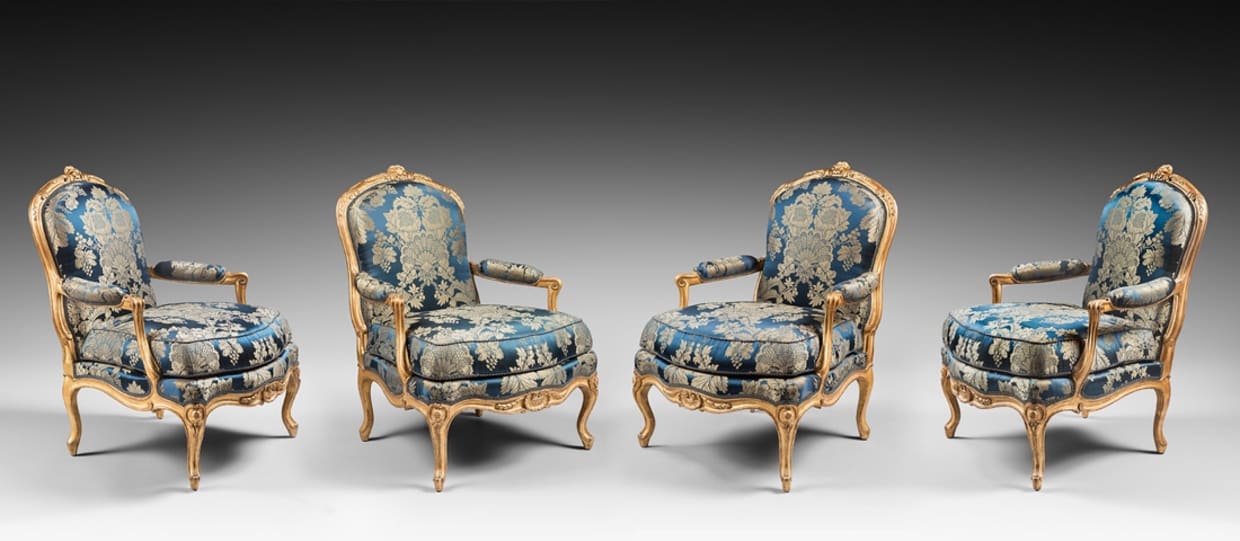
ET OF FOUR ARMCHAIRS
MARKED I. GOURDIN - LOUIS XV PERIOD
In the “A la Reine” style, with a flowing silhouette in gilded, molded wood, richly carved with stylized shells at the center of the crossbars, a motif of cartouches and laurel leaves on the shoulders, and flowers at the tops of the legs; the armrests feature a whip-like curve. The armrests have cuffs. They rest on four curved legs. The distinctive feature of these rare chairs is that they were designed as wide bergère-style chairs with low legs; the structure of their backs suggests that the seats were intended from the outset to accommodate a thick cushion.
Upholstered in quilted checkered fabric.
H. 98 cm. (35 ½ in.), W. 73 cm. (28 ¾ in.), D. 70 cm. (27 ½ in.)